
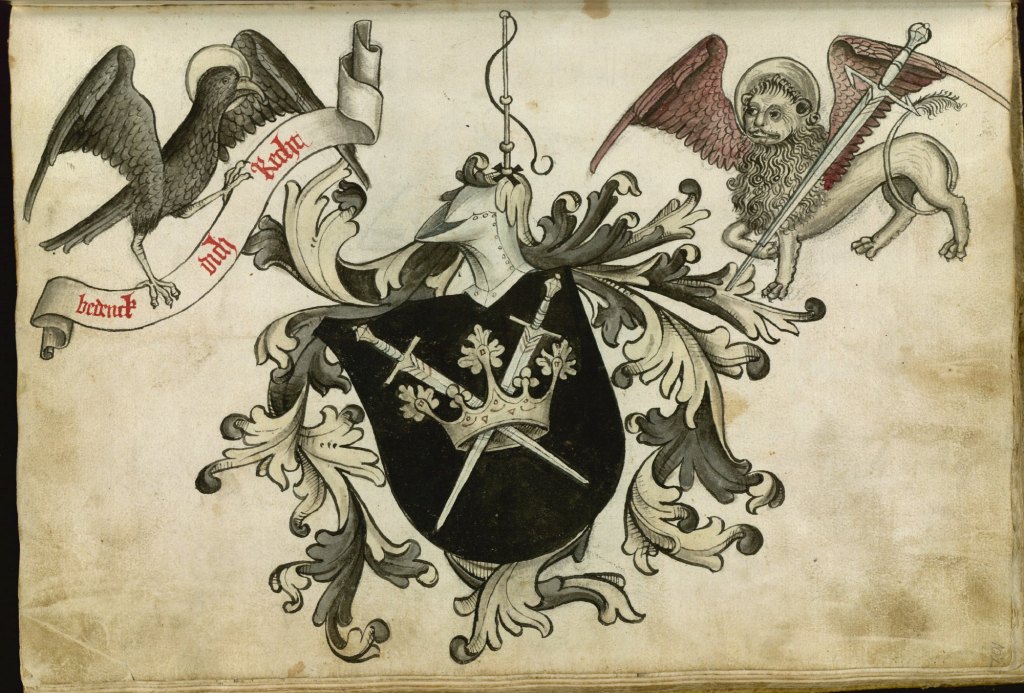
Attribution: Hans Talhoffer’s coat of arms, with motto “Bethink thee right”, by Hans Talhoffer – Ms.Thott.290.2º, Public Domain, https://commons.wikimedia.org/w/index.php?curid=25001544
Hi everyone,
Well, the Chrissy psychosis was abated at work today (yesterday was a word rhyming with witch or so I saw on a sneaky Teams check), and we start the crawl to New Year’s Eve which could peak – you never know.
And we come again to a 5th Sunday of the month. I know I promised before that I’d get to either my favourite historical figure or maybe the evolution of gnats, but the first chance fell by the wayside because of total bipolar disorganisation.
The computer desk is still a mess, but I plotted out a plan, and I’m giving myself some Saturday nighttime to get the ball rolling, and free up some time tomorrow and get my post out by midday.
(Author Update: 07:55, Beat it!!!)
So, I proudly present my first Topic du Jour, the guy who showed me how to get medieval on someone’s ass, Hans Talhoffer.

This is it, last chance to catch chapter two of Three Ways, because I actually have a short story idea for January, and the wherewithal to write it.
Tipped out of his chair, Cole goes across to meet Jane…
Thy Kingdom for a Sword
When I got to writing my first story The Torment, The Shadow, The Heart (currently unavailable because I want to update the prose and get a proper cover done), I always intended to write some epic sword fights, all the exciting bloodshed you could imagine.
And I actually did alright – think the speed of the LOTR fight scenes but with the requisite messy, GOT violence. It certainly isn’t for the faint-hearted, but it does have a drive-home point that combat is brutal.
Granted, I practiced some moves with a broom handle to get right in there with the hand positioning, how a sword would be swung, real formative stuff.
But what I really wanted was a longsword like the main character Halm Dresden. So, I went and brought one.
Hang on a second, you’ve had a psychotic episode and depression, why are you, a headcase, getting an actual weapon that could do epic harm?
As Trent from Punchy says, “Oi, effing relax, eh!” It was blunt, and it’s still hidden behind the computer at my mum’s place about an hour north of where I now live.
Being formally bipolar, having been sectioned, strapped down and sedated, and held in the PECC ward overnight, it would not bode well for me to even bring it down, let alone go and practice with it.
But I did practice with it, first flashy and foppy with terrible footwork and absolutely no idea what I was doing, but hey, I could practice the moves.
Fast forward to that Christmas, and my girlfriend at the time asked me what I wanted, and loving Viking history, I asked for a book on Vikings, a lovely little encyclopaedia on all things Viking – including the brutal raids, sackings, wars, driving monks into the sea, and berserkers.
I was chuffed, I was satisfied, I thought that was it.
Then she handed me another present, which I figured was a book straight away. She mentioned she saw it and thought of me immediately.
Intrigued, I unwrapped it – Medieval Combat: A Fifteenth-century Manual of Swordfighting and Close-quarter Combat by Hans Talhoffer, translated and edited by Mark Rector (here from of amazon.com.au) – and lo, my eyes remained popped for 268 pages.
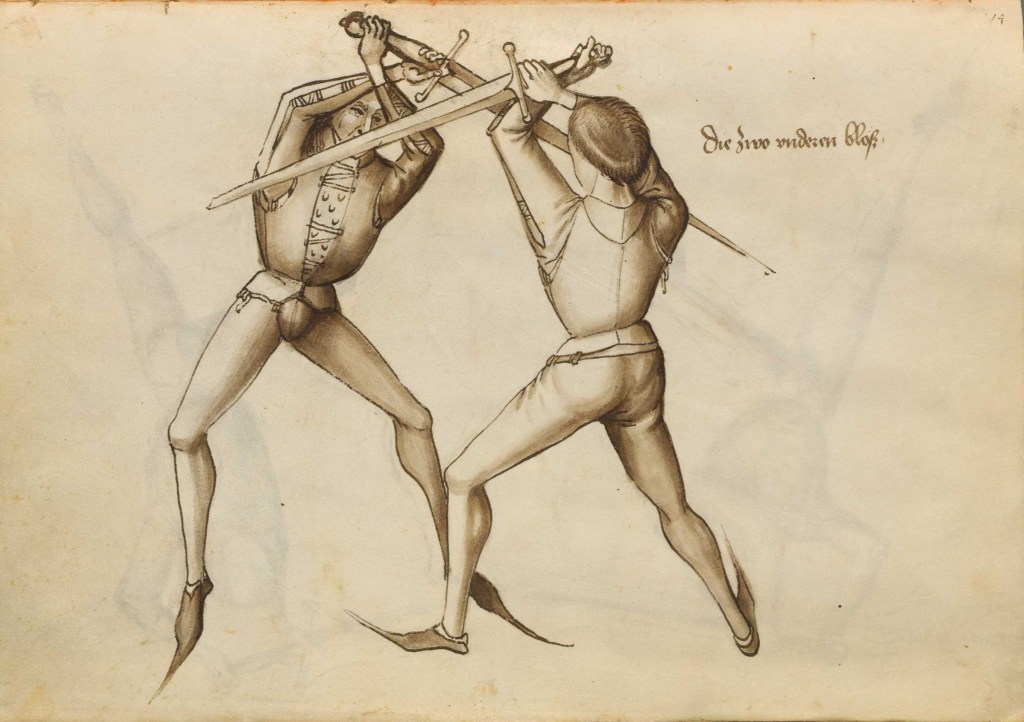
Unarmoured longsword technique by Hans Talhoffer – Cod.icon 394a, Bavarian State Library, processed by McLeod, Public Domain, https://commons.wikimedia.org/w/index.php?curid=4732939
Swordsman, Teacher, Adjudicator, and Scholar
From Wikipedia, Hans Talhoffer – born about 1410-15 and passing after 1482 – was a well-educated Swabic German fencing master of unknown martial lineage who, per his 1459 Fight Book, was familiar with the Twenty Directives of Johannes Lichtenauer.
(Speaking of which, you can catch the free .pdf of the 1459 Fight-Book as Jeffrey Hull’s translation with backgrounds, Fight Earnestly, here on Wayback Machine. Be patient, it’s in colour with lots of pages. Enjoy).
In 1433, he represented the Archbishop of Salzburg Johann II von Reisberg, and in 1434 arrested and questioned in connection to the trial of Nuremberg aristocrat Jacob Auer – a quite controversial trial that caused regional strife for two years after.
In 1437, he was mentioned as a bursary officer in Hohenburg, but sometime between then and authorising his first fencing manuscript in 1433, he settled in his life as fencing master.
This Ms. Chart.A.558, with a largely text-less fencing section also included an astrological treatise and Konrad Kyeser’s Bellifortis – everything about medieval siege techniques and weapons of war, suggesting esoteric interests beyond what he taught best.
He served more than a few noble clients, most notable the Königsegg family of southern Germany, and between 1446 and 1459 produced the Ms. XIX. 17-3 manuscript, before the Ms.Thott.290.2º in 1459, including the Bellifortis, other musings, and esoteric subjects by Jud Ebreesch.
Talhoffer appears in the Zürich in 1454, teaching fencing and adjudicating judicial duels. In one duel a fight broke out among his students, leading to a trop before the city counsel and various fines.
Passing through Emerkingen in the 1450s he trained the brothers David and Buppellin vom Stain, and produced the Ms. 78.A.15 for them, expanding on the
Ms.XIX.17-3 commissioned by Liuthold von Königsegg, he would finally create the Fechtbuch von 1467 (Cod.icon. 394a), commissioned by Count Eberhardt I von Württemberg, and retire sometime after that.
Besides these works and their translations/notes being everything a budding fantasy writer needs to arm their heroes – and become an armchair expert of how horrible movie/show/game fighting really is – Talhoffer was well-versed in judicial combat.
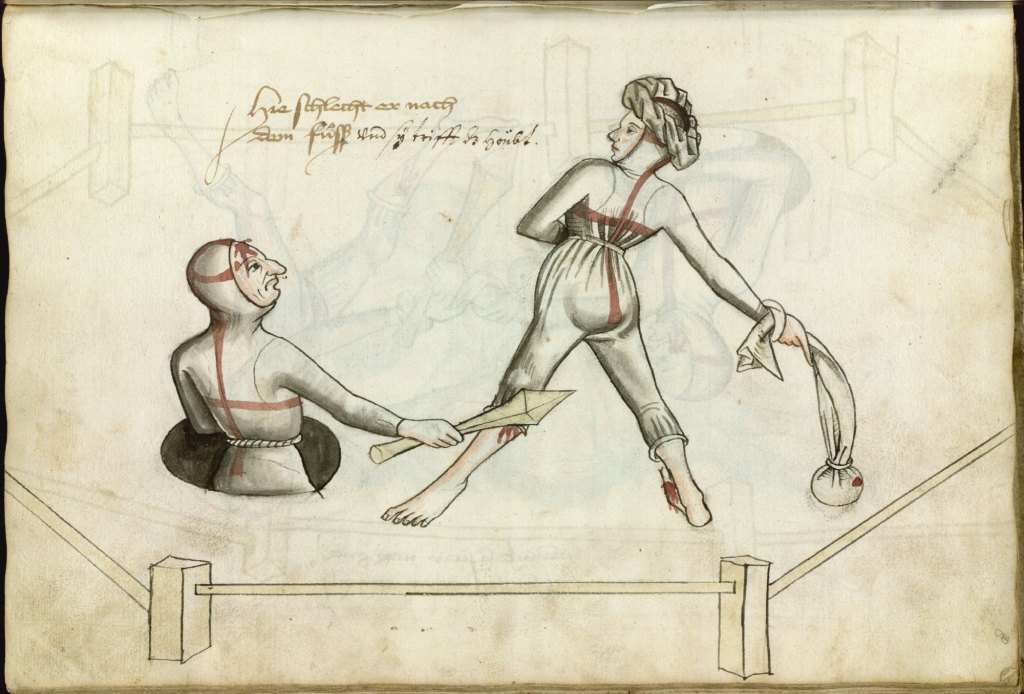
Fight between a man and woman, by Hans Talhoffer – Ms.Thott.290.2º, Public Domain, https://commons.wikimedia.org/w/index.php?curid=25001382
Trial by Combat
More than just methods (sword and shield for Swabia, mace and shield for Franconia using dueling shields), and various shield/weapon modifications in an attempt to even the fight out (as in this fight between a man and woman), the 1459 Thott shows the legal side.
Talhoffer names seven offences that in the absence of witnesses were considered grave enough to warrant a judicial duel, courtesy of Wikipedia and Jeffrey Hull’s translation:
Now those aforesaid causes and articles are seven, wherefor a man has duty to fight: Thus the first is murder. The second is Treason. The third is heresy. The fourth is becoming an urger of disloyalty to one’s lord (desertion, “mutiny” if you will)
The fifth is betrayal in strife or otherwise. The sixth is falsehood (perjury/fraud). The seventh is using either a maiden or lady (taken to meaning rape)
He goes into how to request a judicial duel, with the accuser coming before the court and advocating for himself, and name the accused by baptised name and surname, then takes the accused before the tribunal.
The accuser and accused needing to prove his need and right, with the tribunal deciding whether combat would go ahead.
He lists reasons why someone would not duel, from being within five places of kinship, or that a lame man or one with bad eyes may disregard the duel, unless they could well-manage somehow, which would be resolved by handicaps mentioned above to put both on par.
Further are notes on combatants not hiding, neither fighter being aided by another (a rule enforced by two staff-wielding umpires to hold the crowd outside of the ring), what happens if a fighter is knocked out of the ring or runs away.
Most importantly is the six-week training period, where a combatant would seek someone like Talhoffer to learn how to fight, not long enough to learn all intricacies of Kunst des Fechten (the Art of Fighting) but enough to get by.

A longsword technique for armoured knights, showing half-swording (the knight on the left) to use a sword like a spear, and reverse swording (right), holding the sword by the blade to use as a war hammer or for tripping
By w:Hans Talhoffer – Königsegg-Aulendorf Collection Ms.XIX.17-3, Public Domain, https://commons.wikimedia.org/w/index.php?curid=28879307
All Seasons of Combat
Courtesy of Wikipedia again:
[Talhoffer’s] writings cover a wide assortment of weapons, including the arming sword, buckler, crossbow, dagger, flail, longknife, longshield, longsword, mace, poleaxe, spear, and unarmed grappling, often both armored and unarmored, on horse and on foot, and in scenarios including tournaments, formal duels, and unequal encounters implying urban self-defense.
Kunst des Fechten was a martial art built on principles of attack and counter-attack, disregarding a purely defensive mode which would see a fighter always on the back foot.
Teachers like Talhoffer adapted the Twenty Directives to use with other weapons, and promoted a wrestling form known as Ringen (grapple wrestling, sometimes used in trial by combat) taught by Jud Ott.
But far from artistry, Talhoffer also shows numerous dirty tactics to retain and keep advantage, and it wouldn’t be far off throwing a few punches, going a little WWE, if that’s what it takes – after all, this is “fighting for your neck,” your life.
Armed with one of his fight books, one could enter battle with courage and “good cheer,” no matter the encounter or the weapon you’re handed, whether it’s a judicial duel or actual warfare.
And above all, there is the use of footwork when attacking, which made its way into The Torment, The Shadow, The Heart for added oomph. And as it turned out, I didn’t have to make a lot of changes from my fight scenes to incorporate what I learnt.
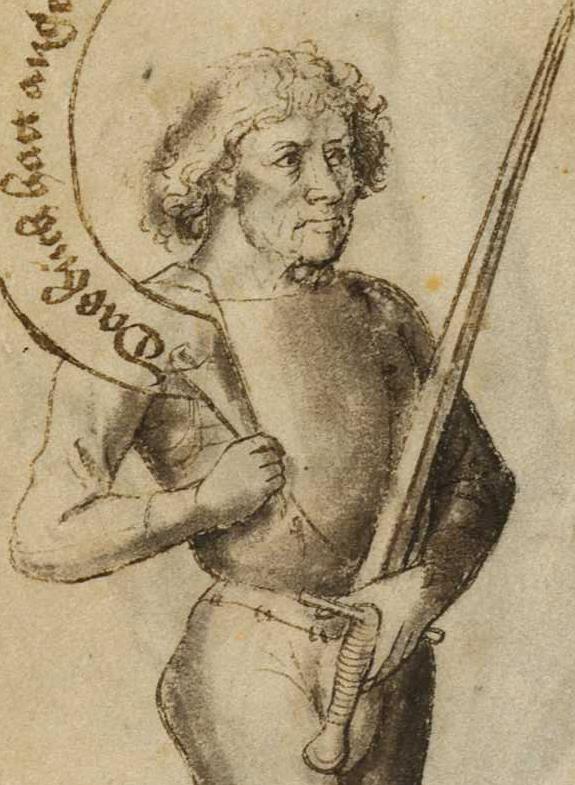
Portrait of Hans Talhoffer by Stefan Schriber (artist), folio 136v of the 1467 fight book – Digital scan by the Bavarian State Library (BSB), Public Domain, https://commons.wikimedia.org/w/index.php?curid=4730753
Needless to say, I’d love to meet this guy, get a good sword fighting lesson in, and talk esoteric interests.
Well, That Turned Out Well
I must say, I really enjoyed writing this post, sharing about my interests, and quite frankly, a very interesting historical figure who isn’t a monarch, playwright, a general, or medic.
And one of these days, I’m going to have to get to Swabia and visit Hans’ stomping grounds, and have pretzels and bier.
I’ll leave it at that, 9 minutes worth of reading, my wish that you had a Merry Christmas, Happy Hanukkah, or enjoyed your seasonal holiday, and my wish that it’s a happy new year for you, or a time of seeking help and solace.
Until next time,
T. M.
2 responses to “Bethink Thee Right”
-

[…] here’s a post about the fight master who’s 1459 and 1467 Fight Books steered the combat scenes in my […]
-
[…] Enjoy Bethink Thee Right. […]




 T.M. Shannon
Leave a reply to Let’s See Where This Leads – T.M. Shannon Cancel reply