
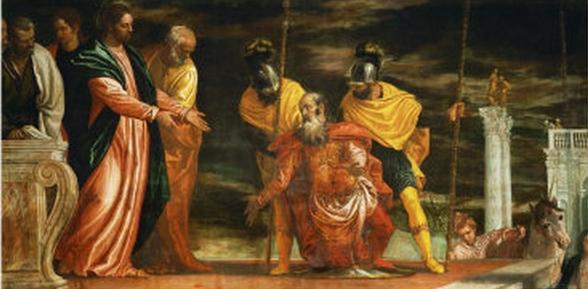
Hi everyone,
Well, it’s almost Christmas, and we got through yesterday at work without much issue despite the traffic volume. Next day I work will be Christmas Eve, and that’s a whole bunch of people picking up their seafood orders early and getting out quick.
And I’m tempted to do a Seasonal post – it’s not just Christmas, there’s a number of festivals like Hanukkah, Bhodi Day, older winter solstice celebrations like Saturnalia, the Yuletide, and Festivus (gotta love the atheists having some fun).
But I reckon that can wait until Wednesday so I can trawl Wikipedia for info tomorrow on my day off, which will be interesting because I, well, Three Ways draft 3.25 is all done except for an affect/effect check, and it’ll be time to start outlining the next project.
Gasp!
Yes, it’s been a slog to get to this point, all that’s left is editor and cover designer, oh, and putting some feedback samples out to see how I’ve done. Thrilling, huh? And it’s certainly refreshing to know that all the stress, pain, tears, breaks, and rewrites are done, and I can relax.
But I digress as always. Please trust me when I say my prose style is very direct. But I couldn’t identify as bipolar without going off on tangents. Thankfully the new med has caught that!
So, here goes with the last of my favourite Biblical moments, healing the Centurion’s servant.
Some Context
Courtesy of Wikipedia:
According to I. Howard Marshall, there were no Roman forces in Galilee prior to AD 44; therefore, the soldier was probably a member of Herod Agrippa’s troops, which modeled Roman organization. Either way, although his nationality is not given, he is clearly a gentile.
This might put Biblical narratives to the test, even in The Chosen there are Roman forces around, and Jesus is dated as living around 6-4 BCE to about 30 CE (aka BC and AD), putting his crucifixion about 14 years before any Romans even coming.
I’ll put this as an argument for another time as I’m sure I could dig up a pile of info.
Further is the meaning of servant, which gets a little interesting:
Luke 7:2 and 7:10 refer to the person to be healed as δοῦλος (doûlos), unambiguously meaning “slave” (interpretatively tr. as “servant”) but has the centurion himself call him παῖς (pais) – which has a number of more ambiguous meanings including “boy”, “child” (e.g., Matt 2:16), “son” (John 4:51), “slave”, and “servant” (Luke 15:26, Acts 4:25).
It’s all about the differences, though this may just be a difference in the words used by different people, the message remains the same.
This use of “pais” did lead to an interpretation of a sexual relationship between the Centurion and his “boy lover,” going even further to propose a jealousy of Jesus coming around and the servant becoming enamoured of him.
This is put to rest pretty bluntly by D. B. Saddington, though he doesn’t exclude the possibility. You can read more on this interpretation, and what the Gnostics think, through the Wikipedia link above.
Now that we’re settled, let’s hear from the Gospels – wait, what, plural?
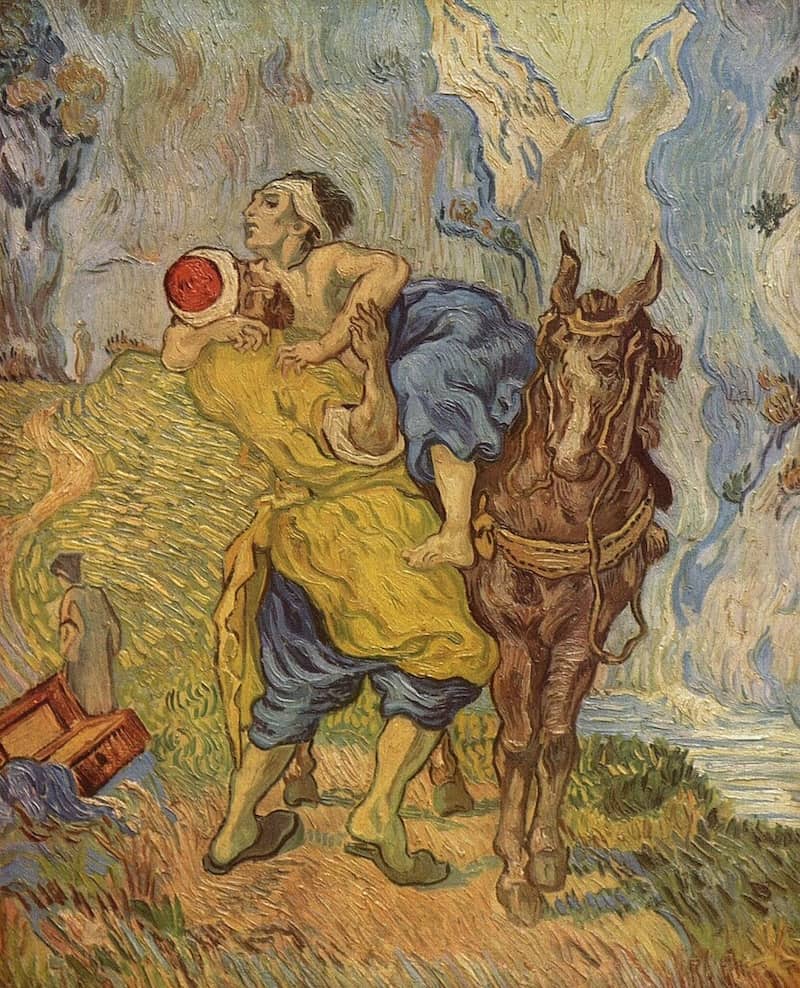
The first of my favourite Bible episodes is the Parable of the Good Samaritan, especially it’s two devout, Lawful men leaving the injured man assuming he’s dead, and the hated outsider, a Samaritan, showing mercy.
Here, I recast these men as two Christians dismissing needs, and a gay man taking him to hospital.
According to St Matthew
Matthew 8:5-13 picks up the story after the Sermon on the Mount (the Beatitudes, the Lord’s Prayer, re-applications of the Law like “love your enemies”), and healing a leper after leaving the mountain, with Jesus going to Capernaum, on the top northwest shore of the Sea of Galilee:
When Jesus had entered Capernaum, a centurion came to him, asking for help. “Lord,” he said, “my servant lies at home paralyzed, suffering terribly.”
Jesus said to him, “Shall I come and heal him?”
The centurion replied, “Lord, I do not deserve to have you come under my roof. But just say the word. For I myself am a man under authority, with soldiers under me. I tell this one, ‘Go,’ and he goes; and that one, ‘Come,’ and he comes. I say to my servant, ‘Do this,’ and he does it.”
When Jesus heard this, he was amazed and said to those following him, “Truly I tell you, I have not found anyone in Israel with such great faith. I say to you that many will come from the east and the west, and will take their places at the feast with Abraham, Isaac and Jacob in the kingdom of heaven.
“But the subjects of the kingdom will be thrown outside, into the darkness, where there will be weeping and gnashing of teeth.”
Then Jesus said to the centurion, “Go! Let it be done just as you believed it would.” And his servant was healed at that very hour.
Nothing like some good old weeping and gnashing of teeth, and a little severity showing the future converts to Christianity, settled by the actual miracle – it’s just done like an afterthought.
One interesting thing I find about Christ’s miracles is they have an innate subtlety to them. There’s no hand waving, no holy or mystical lights, no fanfare or incantations except maybe a word like “Ephphatha” – they’re just done without any fuss.
Yet still, they are profound, such as feeding the masses from a couple of loaves and some fish. Then there’s the one we can all get behind, Jesus bringing the party by turning water into wine – an excellent, quaffable drop perfect for a wedding celebration.
But as I said, this tale is in Gospels, another similar story coming after similar Christian-defining teachings.

My second favourite, which is the one that really popped out at me before I had my born-again moment/manic episode.
Here’s a teaching on paying taxes and belonging to God.
According to St Luke
Luke 7:1-10 picks up the story of the other great teaching of Jesus, this time not on a mountain, repeating parts of these teachings but adding some others, not to mention Jesus coming up against the Pharisees on Sabbath matters:
When Jesus had finished saying all this to the people who were listening, he entered Capernaum.
There a centurion’s servant, whom his master valued highly, was sick and about to die. The centurion heard of Jesus and sent some elders of the Jews to him, asking him to come and heal his servant.
When they came to Jesus, they pleaded earnestly with him, “This man deserves to have you do this, because he loves our nation and has built our synagogue.” So Jesus went with them.
He was not far from the house when the centurion sent friends to say to him: “Lord, don’t trouble yourself, for I do not deserve to have you come under my roof. That is why I did not even consider myself worthy to come to you. But say the word, and my servant will be healed. For I myself am a man under authority, with soldiers under me. I tell this one, ‘Go,’ and he goes; and that one, ‘Come,’ and he comes. I say to my servant, ‘Do this,’ and he does it.”
When Jesus heard this, he was amazed at him, and turning to the crowd following him, he said, “I tell you, I have not found such great faith even in Israel.”
Then the men who had been sent returned to the house and found the servant well.
Ooh, a dose of contradiction. Wikipedia takes this up:
Since Luke does not say that the centurion himself came to Christ, but only sent to Him, first Jews, and then his friends.
St. John Chrysostom, Theophylact of Ohrid, and Euthymius, all hold that these events in Luke happened first and then last of all the centurion came to Christ. He did this “either for the sake of doing Him honour, or because of the urgency of the disease, and the imminent peril of death.”
St. Augustine and Bede are of the opinion that the centurion never came to Jesus but only came in the sense of sending his friends as emissaries.
Guess there’s no settling it then, if Church doctors and thinkers have their differing opinions. Left in this contradiction, how are we to know which one is real when they’re both Gospel and therefore both true (or however you might see it)?
Speaking of that born-again moment/manic episode in 2018, here’s me Finding Faith and Holding onto It, first arriving at Church in August then being baptised in November the day after my birthday.
What Matters is the Message
The ex-atheist in me wants to rail at the contradictions, trust nothing of it, deride me for saying, “It doesn’t matter which one is which,” and have a go at me for falling into hypocrisy or delusion.
But this one struck me given I turned up to Church earnestly before I sat down to the Gospel – a similar phrase is said during the communal rite at the third elevation, after the Lord’s Prayer and Agnus Dei.
The priest, holding the broken paten over the chalice, intones, “Behold the Lamb of God…” and all answer, “Lord, I am not worthy that you should enter under my roof, but only say the word and my soul shall be healed.”
So, when I came upon Matthew 8:5-13, this episode hit home, though I think I get it now, on thinking about this episode.
I feel this is a reminder we’re outside of Eden, outside of Heaven waiting for the Second Coming, admitting that we put utmost faith in a power from afar we can’t see, hear, or taste, to perform this miracle for us as He did for the servant, however they serve the centurion.
I especially felt part of the Bible in being an outsider, not just because at this time of history this is still Judaism and I’ve joined a bunch of schismists, but being atheist, anti-religion, mentally ill, bisexual – and from the get-go, I’ve been showing this faith in my own way.
It’s not a perfect journey, I’m still under slight addictive whims, and sometimes I wonder if I’m sincere or really believe I’m completely unworthy (or it’s just imposter syndrome).
Whatever that answer may be, I get the message, and I keep going to Church to relive the centurion’s faith and believe.
With nothing else Faith/ Religious to link to, and because I didn’t repost this on Friday, here’s last week’s Mental Health/Addiction topic, finding the med that has cleared my thoughts right up.
Thanks for your Ten Minutes of Reading
Yes, I’ve been shorter of late with 7 or 8 minute reads, so thank you for sticking around.
As for the next week, got some timetabling to do, so I can focus on getting outlining/writing done on the next project, get settled with blogging (it’s topic du jour time next week), churn out some short stories so they’re ready to go, and get some Baldur’s Gate time in.
Wherever, whoever, however you are, peace be with you, and if you’re in need, seek help because you deserve it, and have a story to tell.
Until next time,
T. M.
One response to “Faith From Afar”
-

[…] and with Jesus not in the manger yet, I’m reminded of this Gospels (yes, plural) story about Faith From Afar via a gentile’s […]




 T.M. Shannon
Leave a reply to Jesus, Mary, and a Guy Called Santa Incoming – T.M. Shannon Cancel reply