
Hi everyone,
Sorry for the three-week wait, I’m still coming around to organising blogging time, plus someone had to do some writing – finished a couple of chapters so yay me!
But something got me thinking about overused or zero-IQ writing advice: one that gets my particular goat, others even I’ve gotten wrong, counter it with self-realised advice that isn’t opinion, and sprinkle in comment on the psycho/neuro conditions I’m blessed with.
Alright, you lot, here goes something.

How many ways can you look at yourself, or your relationships? Well, can’t do that without starting the relationships, can you?
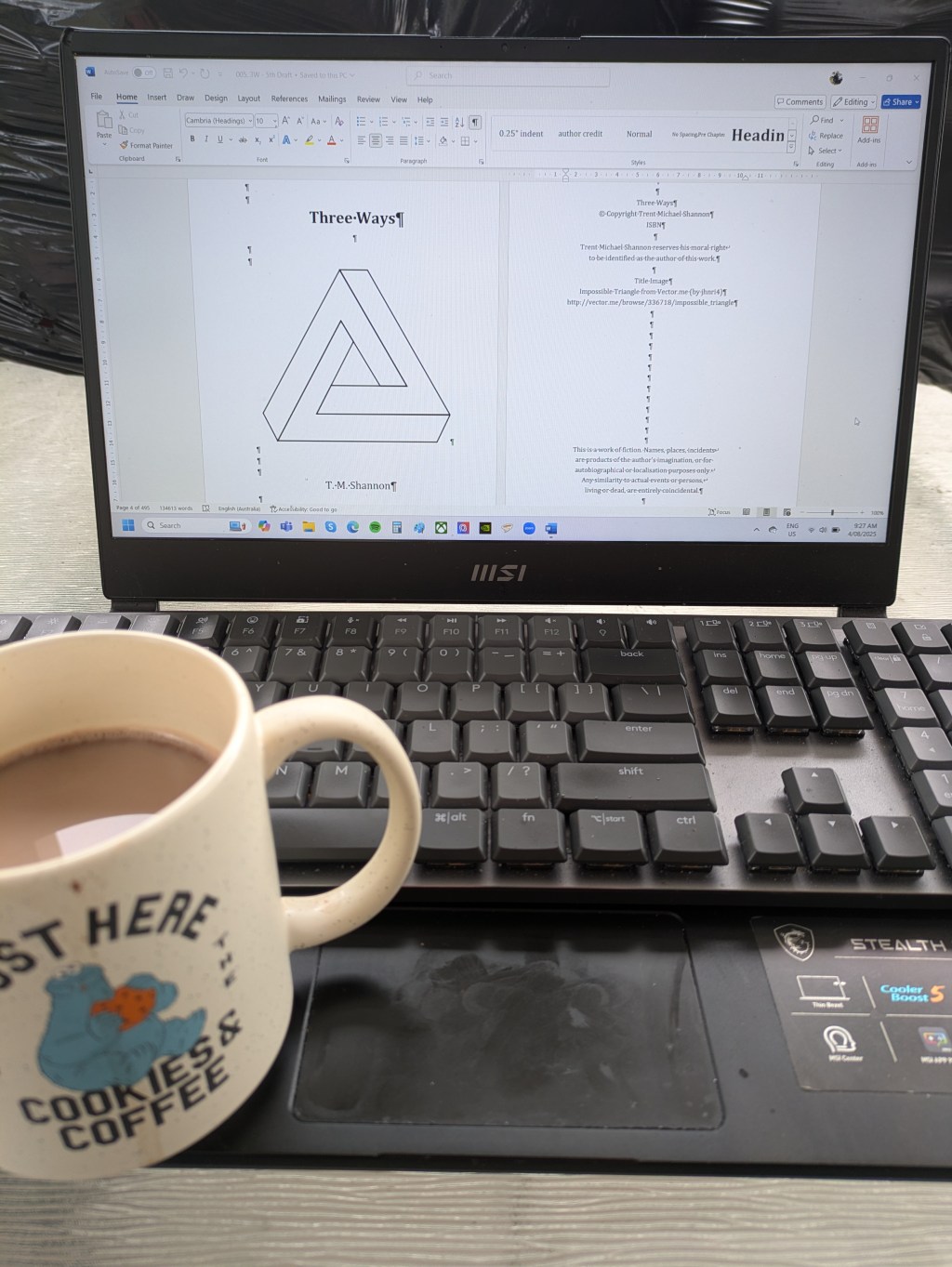
Catch the updated chapter one of Three Ways over on my Promo Page.
Just Plain Impossible
As an author, you look for the advice of those who wrote before you. It isn’t hard to come across titbits on social media – case in point, “The road to hell is paved with adverbs,” attributed to Stephen King, one that I picked up and found I loved.
But it’s a double-edged sword. For good advice that’s healthy to adopt, there’s always something that’s has no IQ behind it, or else it’s One Size Fits All stuff with all nuances thrown to the wind. And none get worse than, “Write every day.”
I’ll be fair, some people can churn out content; others are in the lovely financial setup that gives you a seven-day weekend. Then there’s going hybrid with a career like editing or content writing that gets you ready for a writing sesh of your vampire dinosmut AO3 magnum opus.
And I’ll be honest, I would love, love, love seven-day writing weekends so much that I’d redo that bit channeling Roget with adore, relish, and have l’amour for.
But I have a serious mental illness, a neurological condition, and addiction that require honesty – full disclosure, I forgot my lunchtime Ritalin the other day, didn’t get my Olanzapine last Tuesday – and spent the night talking/vaping with the darling partner awake in pain
I’m okay though. Besides I’m human, I can be forgetful thanks to the whacko states and the neuromess – things have gone into empty synapses and blinked out of existence at times.
But before I drag you all back to Digressi High, “Write every day,” is just plain impossible.
In the most obvious ways, whether you subscribe to Murphy’s Law, or you shot it to pieces like the other Murphy, life happens, and things can get in your way you couldn’t predict unlike the weather person doing paid advertising on location at Sea World.
Could be a dose of the Golden Crowned Lurgy that knocks you out for a week. Your bestie wins tickets for you’d otherwise kill for like going to see reformed NKOTB in Vegas (looking at the darling partner here). Or someone doesn’t come to work and now you’re on a double shift.
Maybe your laptop battery dies. Maybe you moved and lost your notebooks. Or your son pours water on your laptop while you’re not looking and kills it, and you don’t have a gaming computer with spare cables to rip your hard drive out and shove into the tower.
That was a very lucky night, I tell you.
Speaking of, you have kids and their diverse commitments. There’s a trip to hospital or vet. Your car is written off. And, it needs to be said, you get to the point where you scream, “To hell with this writing S.H.I.T!” and go binge the Infinity Saga in timeline order.
Seems plain enough that, “Write every day,” has fallen through a fresh-calved iceberg into the Antarctic cold splashy splashy, and I haven’t even gotten to work, the commute to and from work, spirituality, health/wellbeing practices, seeing your psych, or doing 12 Step.
But here’s where this advice hits with the ugly stick.
An author talking about their authoring? Good.
How the working-class author got to authoring in the first place? Even better.
Here’s A Boy Who Loves the Written Word.
Peak Ableism
Whether it’s something sort-of innocuous like using a cancer patient on chemo working and saying nothing of their condition as example to others to deal with their issues, or outright saying, “You’re just making excuses for yourself,” ableism sucks.
It gets more pervasive of course, but due to not being psycho or neurotypical and on meds that do a lot of heavy lifting to make me functional – but by no means fine – even with the 7-day weekend I still wouldn’t be able to pull this off.
And sure, you could look at the two hours I have free each night and urge me to write then, as unhealthy as vaping and doomscrolling are, the ADHD doesn’t want me to write then. I need that downtime to reset after the day for my health and sanity. But fair, I could quit the vapes.
Like other forms of ableism, especially saying, “You’re just making excuses,” when I’m clear about my mental illness and neurological condition, it hurts to hear, an impossible goal some think they help us reach by shoving us at it, fomenting crippling failure when we don’t.
Or worse, responding with, “You didn’t work hard enough for it,” fomenting a 5-day depression, self-doubt, or self-hatred. We could avoid tasks for ages because we’ll never feel be good enough in some eyes – and, we all know, actually do in some cases.
So, spout it if you will, especially when you’re a high and mighty published author thinking you’ve cracked the Secret of All Writing with braindead advice, and are doing a service. I’ll either call you an ableist, or I’ll just laugh in Bipolar/ADHD and working for a living.
That said, let me give you my positive writing advice to counter that:
Do what you can when you can, and be proud of what you’ve done.
It might be a page, chapter, or start of a 6-hour sesh. It might be the outline for the next project, your, “Side quest,” as my partner calls them, or writing down all the snappy combat dialogue you’d like to use when the Transformers rock up to sex-fight the Vampasaurs.
The main thing is, do, and if you’re just not in the mood, you’re just not in the mood – besides, most of us aren’t being paid by the word count for our works in progress, that comes later. Skip the sprints, word count targets, anything, “You must write now or else!” and relax.
Funny story, I’m a born-again Christian – well, ex-atheist/part agnostic who found God in the height of a manic episode that went very, very public, and led to an overnight stay in hospital.
Here’s me Finding Faith and Holding onto It.
Show Don’t Tell – Except When You Have to Tell
I’m taking a shot at this because you need to look at it with nuance and finesse.
At the basic level, it’s great advice. Don’t tell me the character was sad, show me how sad they are – are they weeping, in absolute tears, ululating in grief? My personal favourite, drop dialogue tags and go with a character action like rearing up to get all aggro.
But it can be taken way too far, and my manuscript assessor pulled me up on this.
I’d gone to great lengths to show the first-meeting conversation in its entirety, from the, “Getting to know you,” questions through to the actual point of the conversation by way of a few good quips. It was part of the, “Writer’s draft,” I’d written, with everything I wanted to tell.
The solution? “You can summarise the boring, expected things.” And with that, tightening other parts, and cleaning up POV issues in the rewrite/restructure, I got my 15-page, 3-chapter first scene down to 8 pages in 1 chapter, with a lot more action.
And there’s that other thing, you have to tell readers the action – along with say a building description, placement of furniture, the colour of important female characters’ dresses at a soirée.
Obviously, you can go too far on this, but some scenes demand more conversation or action. I’m still figuring it out, but if dialogue drives the narrative or brings more out of a character, the telling and description is judicious, and the action suits, you’re doing good.
Go the Full Game of Thrones
And I’m shining a laser pointer at, “Kill your darlings,” like it’s a cat.
This one can get some disdain, even outright hatred, and I saw a post recently likening it to steak (mmm, steak) – cut the fat, kill the flavour – albeit keeping some fat around. Me? I’ll take a marinated lean steak with less fat than Hugh Jackman as Wolverine – there’s the flavour.
Full disclosure, I wrote a horrible fourth and fifth act with late-intro characters and an out-of-character climax, 200k words, 600 pages formatted. Luckily, I chopped those out, but I still had a problem – my magnum opus of a, “Writer’s draft.”
A gazillion points to the manuscript assessor for putting me in the reader’s mind, who I want to keep turning the page, so a lot of darlings are dead, and the second half of the book is going to be less scalpel, more chainsaw along the way to restructuring.
I get it. I like trains, so there were the names of trains in there. I wanted to show Sydney and got neck deep in roads and which direction to turn – also a love letter to an American author who got Australia horribly wrong. I researched the neurotransmitters active in like/love.
No mention on the trains or Sydney (my assessor did not get that far into it because s-l-o-w), and tightening meant bye-bye. As for my half-baked attempt to make Phenylethylamine famous? This dragged my assessor out of the story.
It was true. It turned the working-class narrative into a science textbook. So, if you want a neuroscientist approaching love, go for it!
I’ve been killing the darlings with my rewrite/restructure, replacing them with meaty events – I’m at the same point in the narrative (*ahem* sexy time *ahem*), but so much more has happened, and fast.
Most importantly, my assessor telling me the story is in there, all this cutting, chopping, remixing, and what not is bringing the story out ready for consumption. As for the darling partner checking it out? She says it’s stronger, flows well, and isn’t boring. But, still, editor to go.
My take? Get bloody, no remorse, which I wasn’t necessarily ready to do, but the results of full adoption are incredible – so too the self-criticism and imposter syndrome – but it’s given me room to move, and there’s two chapters about to become one, and another due the chop.
Does it make for the perfect book? I’d like to publish one day, so no. And all it takes is looking at my work critically, my reader in mind – so, skip standard conversation, but keep Mister Darcy’s poodle and Fifty Seconds of Grey.
So, the Zuck in his chudness got rid of 3rd party moderators, and let the frighty righty whities disparage queer people, and I didn’t stand for that.
Here’s me leaving Meta for the sunny Bluesky.
Fine, I’ll Be Quiet Now
Sure, it took me a week and a half, but I reckon that’s a good blog, and hope you enjoyed it.
Don’t forget to follow on Bluesky for the takes in several feeds, and if you check out chapter one of Three Ways, let me know what you think – the author craves feedback like you crave food and air.
Catch you next time, and have a good one.
T. M.
4 responses to “Opinion is Easy Advice”
-
love ya blog
-
Thank you!!!
-
-

[…] Opinion is Easy Advice, and this is a realistic response to it, responding with nuance, and even my own wisdom. […]
-
[…] Go and see what it is, and find my counter to it in Opinion is Easy Advice. […]




 T.M. Shannon
Leave a comment